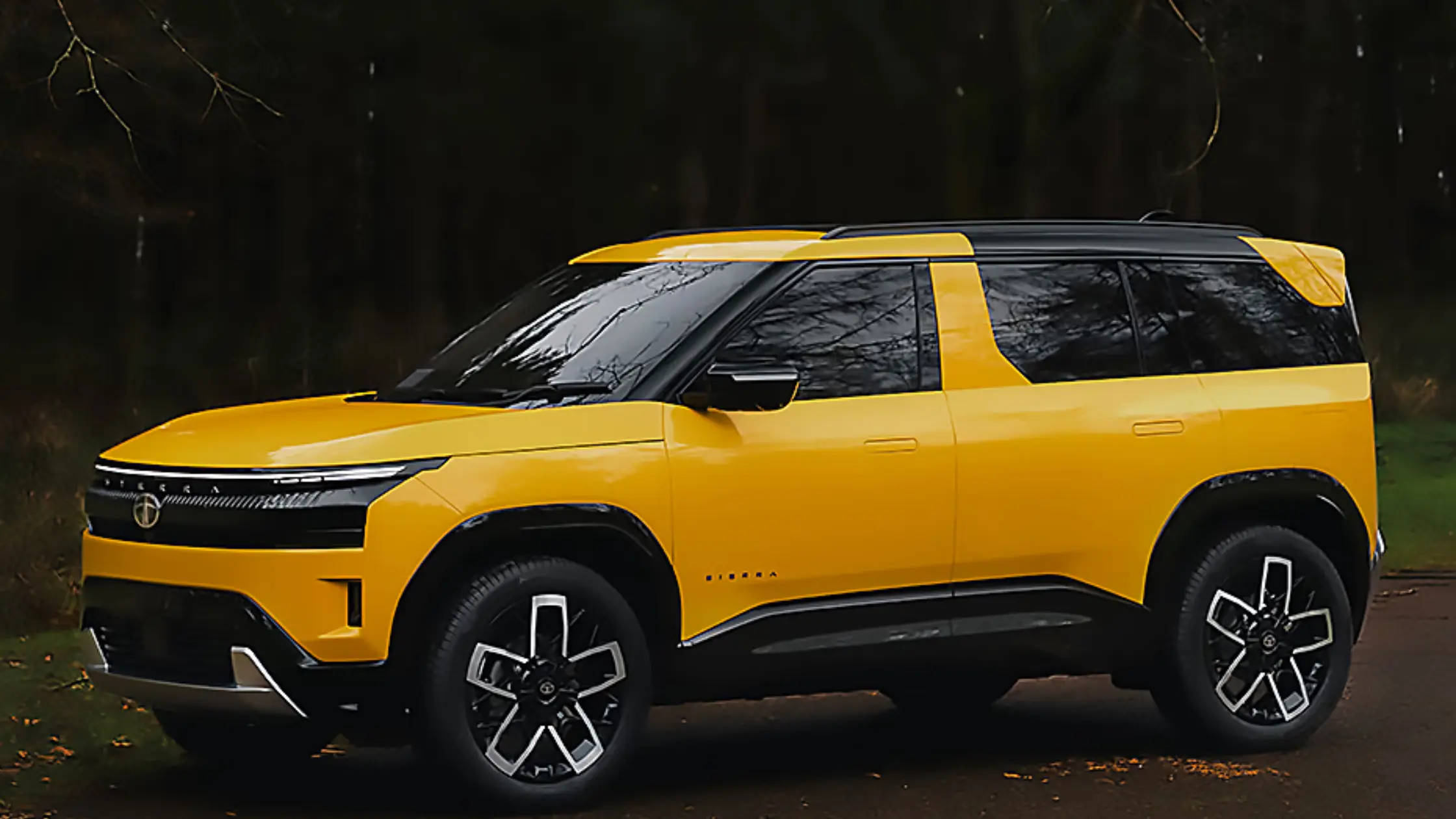
Image source: https://www.cardekho.com/
Tata Motors has officially brought back the legendary Sierra nameplate after nearly three decades, unveiling a radically reimagined version of the SUV that once defined an era. The new Sierra made its global debut recently, marking Tata’s bold return to its heritage roots while blending modern design and advanced technology.
A Nostalgic Comeback with a Contemporary Twist
The original Tata Sierra, produced during the 1990s, remains a cult classic for its boxy, rugged charm. Tata Motors has now tapped into that nostalgia by retaining a reminiscent silhouette in the new model — but the 2025 Sierra is far from a retro throwback. It’s a carefully balanced revival that fuses legacy design cues with modern sensibilities.
At the front, the SUV sports a sculpted bonnet complemented by sharp character lines and a blacked-out grille, integrated with an illuminated “SIERRA” nameplate that gives it a distinctive identity. Slim LED headlamps, a full-width LED light bar, and LED fog lights lend the new Sierra a futuristic yet rugged face. On the sides, the SUV’s profile is upright and commanding, featuring dual-tone alloy wheels, contrasting exterior finishes on its A, B, C, and D pillars, and a painted treatment meant to evoke the classic wraparound-glass effect — a nod to the original Sierra’s design. Adding to its modern SUV stance are roof rails, flush door handles, black ORVMs (outside mirrors), a shark-fin antenna, and pronounced wheel arches.
At the rear, a wide tailgate, connected LED tail lamps, and a bold “SIERRA” badge dominate — reinforcing the vehicle’s strong, muscular presence.
A Feature-Packed, High-Tech Interior
The cabin of the new Sierra brings a level of innovation previously unseen in Tata’s lineup. Teasers released by the company confirm a triple-screen layout — featuring a digital instrument cluster, a central infotainment touchscreen, and a co-driver display. This layout, a first for Tata, immediately signals that the Sierra is aimed at customers wanting both nostalgia and cutting-edge technology.
Further inside, the dashboard is reimagined with a fresh design, though familiar elements like the climate control setup, gear selector, and steering wheel hint at continuity with Tata’s other premium SUVs. The second-row seats appear to be quite comfortable: individual headrests, window shades, and high-quality upholstery figure prominently in the teaser images.
On the features front, the Sierra doesn’t disappoint. It’s expected to come with Level-2 ADAS (advanced driver-assistance systems), a panoramic sunroof, ventilated front seats, dual-zone climate control, and connected-car technologies. Premium touches like multi-colour ambient lighting, a JBL sound system, wireless phone charging, and carefully designed armrests for front and rear occupants are also anticipated. For safety, Tata is likely to offer multiple airbags, electronic stability control (ESC), tyre pressure monitoring (TPMS), and front and rear parking sensors.
Powertrains: Both Old-School and Future-Ready
One of the biggest stories behind the Sierra’s comeback is its multi-powertrain strategy. Tata will first launch the ICE (internal combustion engine) variant on November 25, 2025, with an electric (EV) version expected to follow later.
The ICE version is likely to offer a variety of power options: a 1.5-litre naturally aspirated petrol engine, a 1.5-litre Hyperion direct-injection turbo-petrol, and a 1.5-litre diesel engine. Transmission choices are expected to include both manual and automatic boxes, with multiple drive modes and terrain settings — similar to Tata’s larger SUVs.
Pricing, Positioning, and Competition
Tata seems confident about pricing the Sierra to make a strong impact. According to current estimates, the new Sierra’s ex-showroom price could range between ₹13.50 lakh and ₹24 lakh, depending on variant and powertrain. This pricing bracket aligns it against some serious competition in the Indian compact SUV segment, including the Mahindra Thar Roxx and the MG Hector.
Interestingly, reports suggest dealerships have already begun accepting unofficial bookings, even though the formal launch is still a few days away. According to CarDekho, the initial bookings for the ICE version are underway, and Tata might follow up soon with the EV model.
Why This Matters
The revival of the Sierra represents more than just a nostalgic play. For Tata Motors, it is a strategic move that strengthens its SUV lineup while leveraging its storied heritage. It signals the company’s intent to compete aggressively in the high-volume compact SUV space, but also to future-proof its offerings by introducing an EV variant.
Moreover, launching the Sierra under the current regulatory and economic environment — particularly within India’s broader Goods & Services Tax (GST) framework — could offer Tata a tactical advantage in terms of pricing and volume.
Tata’s revival of the Sierra is a carefully calibrated bet: blend the past with the future, and deliver a vehicle that taps into emotional resonance without compromising on modern expectations. If the final product lives up to the teasers and speculation, the new Sierra could well become a pivotal model in Tata’s SUV portfolio.
Disclaimer: This article is based on publicly available information released by Tata Motors and media reports. Final specifications and launch details may vary.